
IELTS Overview
The International English Language Testing System (IELTS), introduced in 1980, is a standardized test designed to evaluate the language proficiency of non-native English speakers. This test is crafted to access an individual’s ability to understand and use the English language in academic and general contexts. It is widely accepted by universities, employers, and immigration authorities in English-speaking countries.
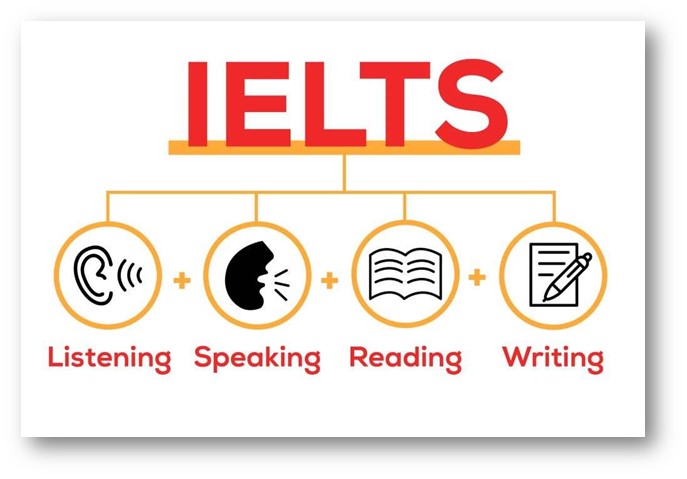
How many versions of IELTS Test are there:
IELTS Academic:
This version is typically required for admission to universities and other educational institutions. It assesses a candidate’s ability to understand and use academic language and skills.
IELTS General Training:
This version is often required for immigration purposes, work experience, or training programs. It assesses general English language proficiency in a practical, everyday context.
IELTS Test Modules:
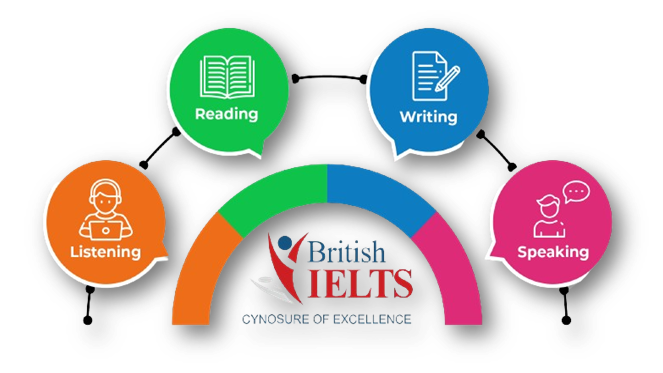
Test Section | Time Allocation | Number of Questions | List Items | Scoring |
| Listening | Approximately 30 minutes | 40 (10 questions per section) |
| Each correct answer is awarded 1 point. The maximum raw score is 40 and converted to a band score on a scale from 1 to 9. |
| Reading | 60 minutes | 40 (Academic) or 40 (General Training) |
| Each correct answer is assigned 1 point and converted to a band score on a scale from 1 to 9. |
| Writing | 60 minutes | 2 Tasks |
| Each task is scored on a scale from 0 to 9. The scores for both tasks are averaged to determine the final Writing band score. |
| Speaking | 11-14 minutes | 3 Parts |
| Each part is scored on a scale from 0 to 9 based on various criteria such as fluency, pronunciation, vocabulary, grammar, and coherence. |
The Overall Band Score is the average of the four individual module scores (Listening, Reading, Writing, and Speaking) which is reported on a scale from 1 to 9, with half-band increments.
IELTS results are usually available online 13 days after the test date. Each module is scored independently, and the Overall Band Score is a rounded average of the four individual scores. The scoring system allows for a comprehensive evaluation of a candidate’s English language proficiency across different skills.
Test Duration:
The total test time is 2 hours and 45 minutes.
The listening, reading, and writing modules are usually conducted on the same day, while the speaking test may be scheduled on the same day or up to a week before or after the other modules, depending on the test center’s arrangement.
Validity:
IELTS scores are typically valid for two years.
Registration for IELTS:
Candidates can follow these simple steps, to register for the IELTS Test:
- Start by locating an official IELTS testing facility in your location.
- Next, pick a suitable examination date from the available choices.
- Enroll for the test either through online registration or in-person submission, providing your personal information and specifying the test variant (Academic or General Training).
- Complete the payment of the prescribed test fee, and subsequently, you will receive a confirmation email containing your test particulars.
- Get ready for the examination by acquainting yourself with the structure and practicing with sample queries.
- On the examination day, make sure to arrive promptly at the assigned testing center, accompanied by your identification document.
IELTS Score Scale
Brand Score | Level of Proficiency |
| 9 | Expert User |
| 8 | Very Good User |
| 7 | Good User |
| 6 | Competent User |
| 5 | Modest User |
| 4 | Limited User |
| 3 | Extremely Limited User |
| 2 | Intermittent User |
| 1 | Non-User |
| 0 | Did not attempt the Test |
IELTS preparation classes available in Kathmandu Valley
If you’re considering taking the IELTS test in Kathmandu, make sure to visit us for exclusive benefits. Explore our special promotions and receive the assistance necessary for a successful experience in your IELTS endeavor.
Benefits of preparing IELTS from Pathseed Consulting
1. Individual Attention
We offer the distinct benefit of receiving individualized attention. This personalized approach ensures that your specific needs and challenges are addressed, contributing to a more effective and tailored preparation experience.
2. Unlimited Mock Tests
We offer the option of unlimited mock tests which enables the candidates to extensively practice and familiarize themselves with the IELTS test format, enhancing their readiness and boosting confidence for the actual examination.
3. Two hours classes per day
We provide two-hour classes each day, offering a structured and consistent approach to IELTS preparation.
4. Flexible Timing
We ensure convenience through flexible timing, allowing individuals to tailor their IELTS preparation schedule to meet their specific needs and commitments.
5. Experienced Instructors
We provide qualified and experienced instructors with expertise in teaching IELTS. Instructors may be native English speakers or highly proficient in the English language.
Note: You can either join an IELTS class or stay at home and prepare for the IELTS test using the internet as your main resource.